Custom Solar-Powered Parking Facilities for Two Remote South Island Sites
Remote locations, harsh weather, limited connectivity and a two-month delivery window made this a demanding project.
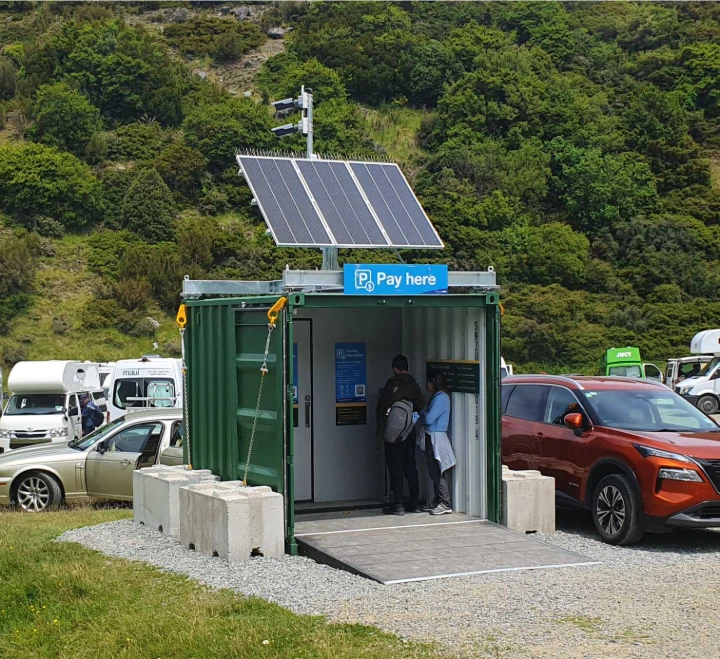
For a paid parking trial at two significant South Island visitor sites, Dualcom designed and fitted out three 10-foot containers and one 4-foot container with custom solar power management systems. The installations needed to support parking machines, license plate recognition (ANPR/LPR) cameras and communications equipment, while providing public access and practical servicing in challenging conditions.
Delivered in collaboration with
Stellar and the end client, the systems went live on 16 December 2025, just two months after the start of design and fabrication.
Turning Containers into Parking Infrastructure
The project required much more than fitting solar panels and batteries to shipping containers. Each unit needed to function as an integrated facility, bringing together power generation, energy storage, communications, parking equipment and service access.
For the three 10-foot containers, Dualcom fabricated internal partition walls to create a separate service area. This provided dedicated space for the power and control equipment alongside a public-facing area for the parking machines. Public entry points incorporated wheelchair ramp access.
The smaller 4-foot container was configured specifically for camera enforcement, supporting LPR equipment without physical parking machines.
This combination allowed the facilities to suit different operating requirements across the two sites while sharing a common approach to power management and servicing.
Custom Solar Frames Built Around the Containers
Dualcom designed and fabricated custom solar frames that could be lowered into position onto each container.
The frames brought the solar arrays and cable management together as part of the container installation. Integrated service wells provided connection points within the frame, keeping wiring organized, enclosed and accessible for maintenance.
The solar structures also had to account for the exposed locations. Wind loading, winter snowfall and protection from wildlife all influenced the design.
Intelligent Power Management with Two Battery Banks
At the center of each installation is a custom battery management system integrated with the parking machines, LPR equipment and communications hardware.
The battery arrangement uses two separate banks, with one providing redundancy when the main supply becomes depleted. This gives the system an additional reserve during extended periods of poor solar generation.
When battery levels become low, the system sends a notification to the car park technicians so a battery changeover can be arranged. This combines remote visibility with a practical response for prolonged bad weather, when solar charging alone may not replenish the energy being consumed.
Dualcom also designed a custom sliding drawer system for the battery banks, making them easier to access, inspect and exchange. In a remote installation, serviceability matters: technicians need to reach the equipment and complete changeovers efficiently.
Remote Monitoring and Access Control
Remote monitoring allows the power systems to be checked without travelling to site. Operating information includes battery state of charge, battery voltage, solar charging performance and load current.
Together, these readings help show how much stored energy remains, what the solar array is producing and how much power the connected equipment is using. This supports maintenance planning and helps technicians investigate changes in system behavior.
Remote access control adds the ability to manage the installation alongside monitoring it, providing a practical way to support equipment located a considerable distance from the workshop.
Connectivity Beyond 4G
Reliable communications were another challenge. At one site, 4G connectivity could not adequately support the installation, so each container at that location was equipped with Starlink.
This provided an alternative communications path for the connected systems and remote power management. Accounting for connectivity as part of the overall design was essential: remote monitoring is only useful when the installation can communicate.
Protecting the Systems from Kea
The local wildlife introduced a less conventional engineering requirement.
Kea are curious birds with a particular interest in exposed fittings and cabling, and their investigations can cause substantial damage. Dualcom therefore enclosed cabling and used galvanized conduit to protect cable runs.
Connection points were housed within the service wells integrated into the custom solar frames. Reducing exposed wiring helped protect the systems while retaining access for technicians.
Managing Wind and Overturning Forces
The solar arrays create a substantial surface for wind to act on, making stability a key consideration at these exposed sites.
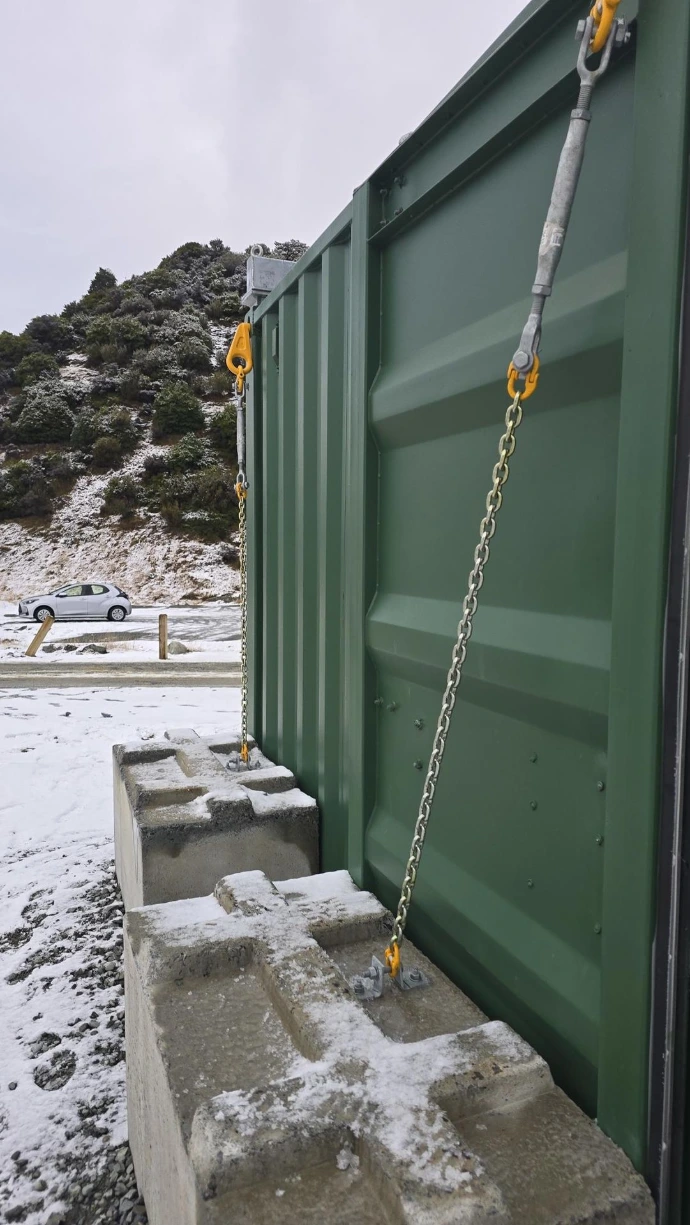
Because the installations formed part of a trial, the solution also needed to suit a temporary deployment. Four one-tonne concrete ballast blocks were positioned at the corners of each container and tethered using chain rigging to resist overturning forces.
This arrangement addressed the wind loads acting on the container and its solar structure while allowing the facilities to be removed or relocated following the trial.
Preparing for Winter Snow
Heavy winter snowfall presented a further challenge for both structural loading and solar generation.
Dualcom selected a specific panel tilt to encourage snow shedding and applied a special-purpose ceramic coating to the panels. The coating was selected to help keep the glass clean and allow snow to slide off more easily, while maintaining the integrity of the solar panel glass and encapsulation.
These measures were intended to reduce snow accumulation and help the arrays return to useful generation after snowfall.
From Design to Operation in Two Months
Within two months, Dualcom completed the design, custom fabrication, fit-out and delivery of all four systems.
The finished installations brought together container modifications, accessible public entry, custom solar structures, dual-bank battery management, remote monitoring, communications and integrated parking equipment.
Going live on 16 December 2025, the project demonstrated Dualcom’s ability to turn a demanding brief into practical infrastructure for remote visitor sites - balancing public use, technician access and the realities of operating through South Island weather.
Planning a remote power or container-based infrastructure project? Contact Dualcom to discuss a custom solution built around your equipment, location and operating requirements.